SCO summit: Iran’s opportunity to contain unilateralism
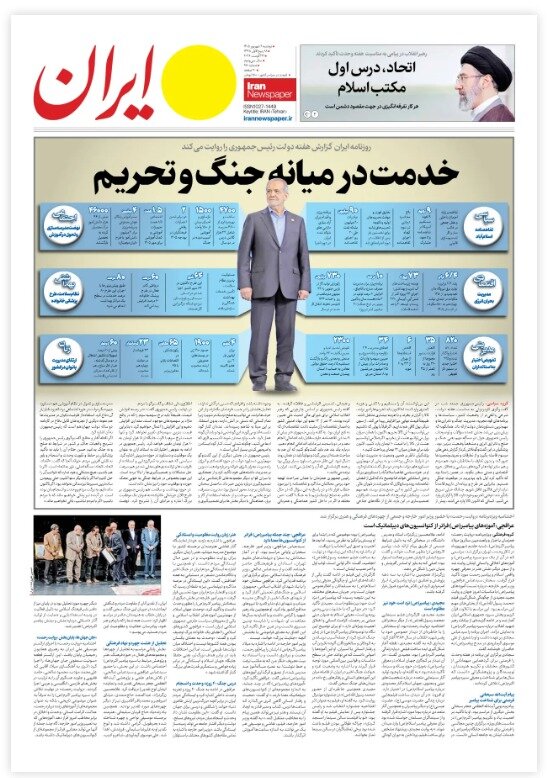
The Iran newspaper, in an analytical article, refers to Masoud Pezeshkian’s trip to Bishkek to attend the Shanghai Cooperation Organization summit. Given the ongoing Iran–US war and its consequences for regional and global order, this visit should not be viewed as a routine diplomatic appearance.
Instead, it represents a strategic opportunity for Iran to redefine its position within the Eurasian axis and encourage Tehran’s key partners to take on a more active role in shaping the emerging order in West Asia. For Iran, the summit carries two layers of importance: First, as a full member of the SCO, Iran seeks to consolidate its membership and transform it from a symbolic status into a practical instrument. Second, the summit provides a diplomatic platform for Iran to deliver direct and unfiltered strategic messages to Beijing and Moscow at a moment when the United States is applying intense military and economic pressure. Pezeshkian’s trip is a significant test for Iranian diplomacy at a highly sensitive moment, and an opportunity to safeguard national interests.
Hamshahri: Iran will not be containable or sanctionable
Hamshahri focuses on the ineffectiveness of US economic sanctions against Iran. Citing former diplomat Seyyed Ali Saghaeian, the paper notes that Washington’s so‑called “crippling sanctions” began in the 1990s and continued through the Trump administration. US officials repeatedly claimed that Iran would be unable to withstand such pressure. However, after a decade, it became clear that Iran had learned how to bypass sanctions effectively and continued its trajectory—achieving notable progress in scientific, economic, military, and other fields. Iran has consistently demonstrated that it cannot be isolated or broken through sanctions. Therefore, the US Treasury’s recent announcement of a new “comprehensive sanctions package” is described as largely symbolic and rhetorical—an attempt to compensate for Washington’s failures through heavy publicity. Even international observers and American analysts believe these new claims are unlikely to succeed.
Siasat-e-Rooz: The US and Israel are enemies of the Islamic world
In its editorial, Siasat-e-Rooz stresses the need for unity across the Islamic world. Recent regional developments show that hostility from the United States and Israel is not limited to Iran or the regional resistance axis; rather, they are adversaries of the entire Islamic world. During the Ramadan War, the US openly stated that the security of Arab states held no value for Washington. Therefore, Iran’s resistance against the US and Israel is not merely an effort to protect itself—it is portrayed as a defense of the broader Islamic world. The time has come for Muslim nations to support one another against the enemy and to pursue synergy across all aspects of material and spiritual life—wealth, security, knowledge, and progress—toward the creation of a new Islamic civilization. Iran is prepared to lead this path and extend a warm hand of friendship to Muslim nations, offering its capacities for collective advancement.
Donya‑e‑Eqtesad: Iran in the “grey zone”
Donya‑e‑Eqtesad offers an interpretation of Iran’s foreign policy, arguing that the country lacks a coherent and unified strategic doctrine. The paper introduces the concept of the grey zone or multialignment, which it defines as “walking on the edge of balance.” In this approach, states no longer need fixed alliances or long‑term strategic blocs; instead, they can maintain tactical relations with all countries based on national interest. According to the paper, Iran’s geopolitical position requires such a grey‑zone strategy—neither falling into the orbit of the West nor becoming trapped by the East. In this zone, Iran can interact with all major actors. Iran is a bridge at the crossroads of global geopolitics, a “geographical shield” connecting East and West. This position is a strategic lever provided by Iran’s historical geography, and the country must use it wisely. For Iran’s long‑term security, its economy must be integrated with the global economy so that Iran’s security becomes intertwined with global security.
Arman-e-Melli: Controlling regional tension is the priority
In an interview with international‑affairs analyst Seyyed Jalal Sadatian, Arman-e-Melli evaluates the visit of Pakistan’s army chief, Asim Munir, to Tehran. After the Islamabad agreement was signed, the Americans violated it and launched attacks on southern Iran. However, they were met with a strong Iranian response—one they had not anticipated, especially given Iran’s economic challenges. Arab states then attempted to persuade Washington to avoid further escalation, fearing that they would suffer the greatest losses. With US midterm congressional elections approaching in November, it appears Washington sought to manage tensions rather than escalate them. According to Sadatian, mediators have now resumed efforts. Pakistan, which maintains good relations with the US, has brought Washington’s message to Tehran. Pakistan has stated that, in good faith, it has attempted to help and will continue working to control regional tensions. Iran has welcomed this approach.
Leave a Comment